


How to Clean a Jellycat Without Ruining Its Fur
Jellycats are cute, soft, and somehow always get covered in snack crumbs, mystery stains, and whatever your child dragged them through that day. The good news? You can clean that favorite little toy without ruining its fur.
Before you start, always check the care label. Jellycat makes many different styles, so the instructions on your specific plush come first.
What You’ll Need
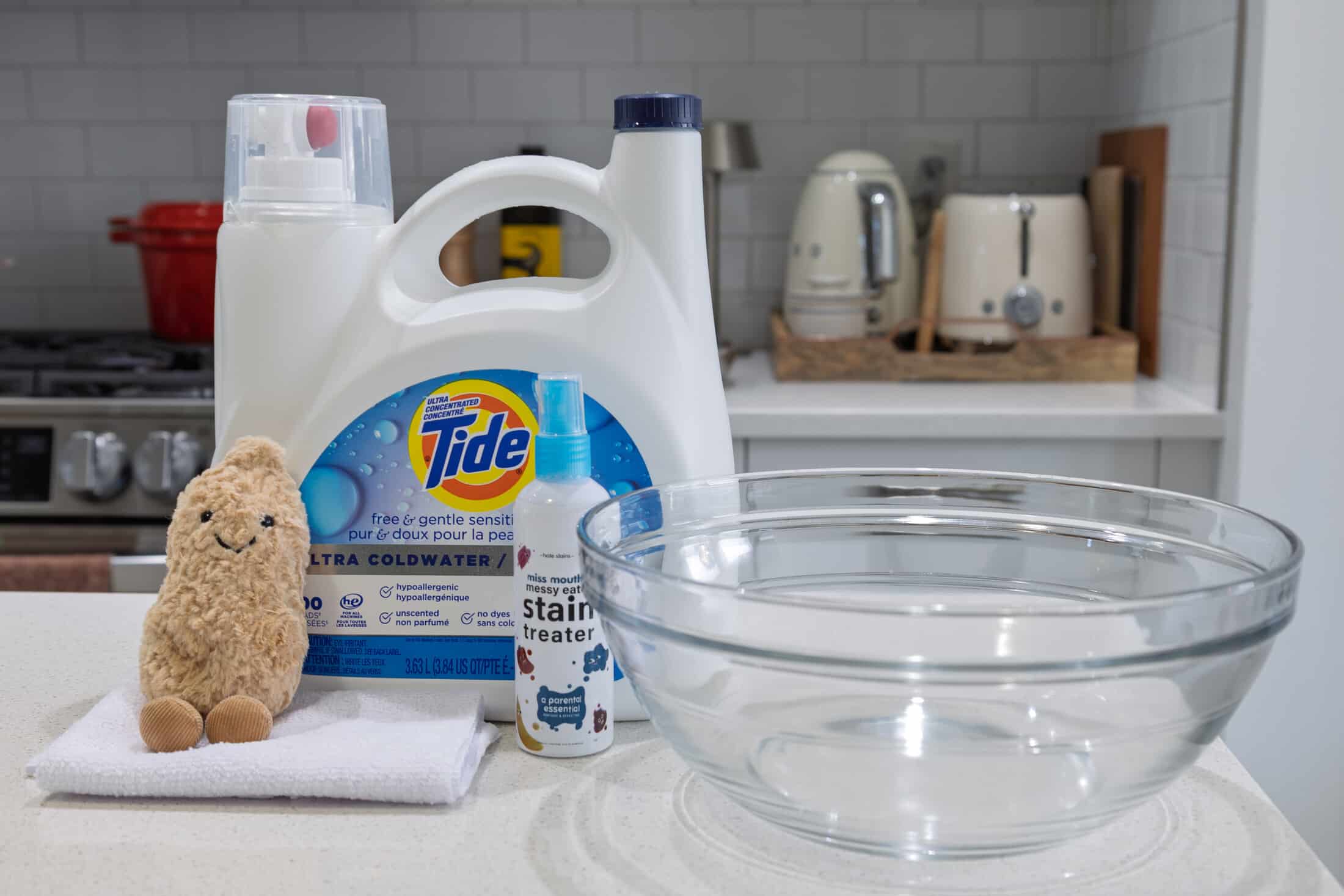
- Mild, fragrance-free liquid laundry detergent (USA | Canada)
- Gentle stain pretreatment, like Miss Mouth’s® (USA | Canada)
- Cool or lukewarm water
- Clean microfibre cloth
- Soft toothbrush
- Bath towel
- Mesh laundry bag or zippered pillowcase, if machine washing is permitted (USA | Canada)
- Fan for faster drying
Avoid bleach, fabric softener, strong stain removers, and hot temperatures.
When you buy through our links, we may earn a small commission.
How to Spot Clean a Jellycat
If you’re dealing with one sticky paw or a small mystery stain, there’s no need to wash the whole thing.
- Mix cool water with a drop of mild laundry detergent.
- Dip in a clean microfibre cloth and wring it out well.
- Gently blot the stain. Don’t scrub or you could tangle or damage the fur.
- Wipe again with a clean, damp cloth to remove soap residue.
- Blot with a dry towel and let air-dry completely.
For stubborn spots, use a soft toothbrush to gently work the solution in the direction of the fur.
How to Hand Wash a Jellycat
If the care label allows it, hand washing is a gentle option for a deeper clean.
If there are any visible stains, pretreat them before washing. You can use whatever stain treatment you have on hand, but we love Miss Mouth’s® here because it’s gentle. Apply it to the stain according to the product directions, then continue with the hand wash.
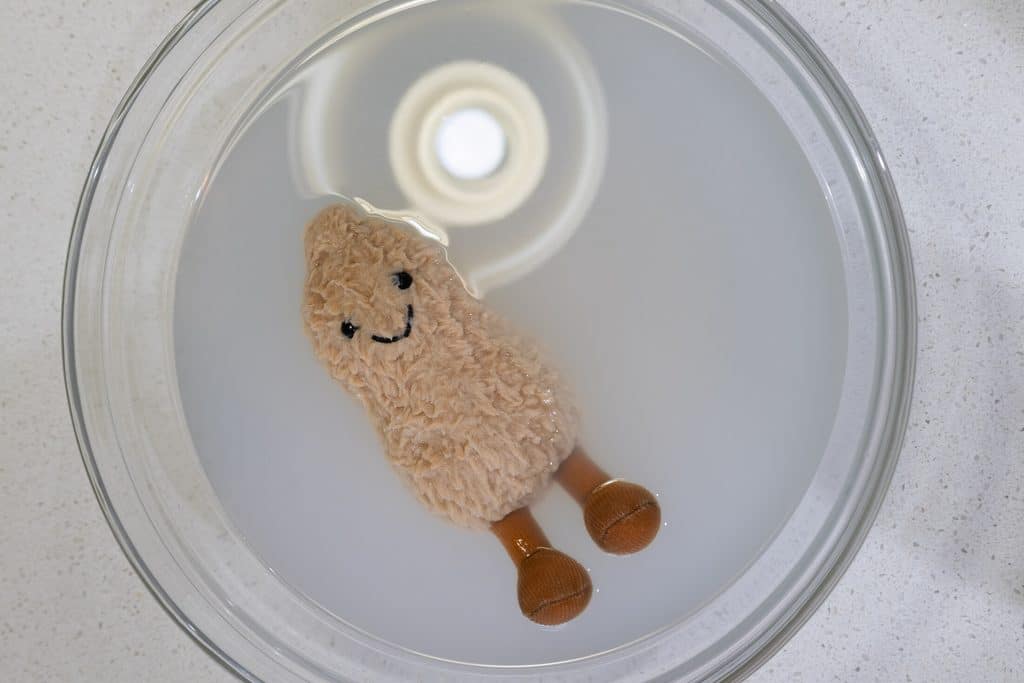
- Fill a clean sink or bowl with cool or lukewarm water and a small amount of mild detergent.
- Submerge the Jellycat and gently press the soapy water through it.
- Let it soak for 10–15 minutes.
- Drain and rinse thoroughly with clean water.
- Gently press out as much water as possible.
Don’t wring or twist it. This can damage the filling and change its shape.
Can You Put a Jellycat in the Washing Machine?
Only if the care label specifically says you can.
Pretreat any stains before it goes into the wash. Use your favorite stain treatment according to the directions.
Place it inside a mesh laundry bag or zippered pillowcase and wash on a gentle cycle with cold water and a small amount of mild detergent. Choose a low spin if possible, and skip the bleach and fabric softener.
Wash it alone or with soft towels, not alongside zippers, hooks, or rough fabrics that could snag the fur.
How to Dry a Jellycat
Air-drying is the safest choice.
- Lay the Jellycat on a clean, dry towel and gently press out moisture.
- Reshape the body, ears and limbs.
- Leave it flat in a warm, well-ventilated area or on a drying rack.
- Turn it occasionally so it dries evenly.
- Once mostly dry, fluff the fur with your fingers or a soft brush.
A fan can help speed things up. Avoid the dryer, radiator, or hot hair dryer unless the care label specifically allows it. Heat can damage or mat the fur.
Make sure the stuffing is completely dry before putting it back in a bed or toy box. Damp stuffing can lead to odors and mold.
When Your Child Needs It Back Immediately
We know. Bedtime is approaching, the Jellycat had an incident, and negotiations have failed.
Spot clean instead of soaking it whenever possible. Press out as much moisture as you can with dry towels, then park it near a fan and rotate it regularly. A hair dryer on the cool setting can also help.
If a full wash is unavoidable, it might be time to introduce the backup stuffy or explain that Jellycat is having a spa night.
What Detergent Should You Use on a Jellycat?
Stick with a mild, fragrance-free, dye-free detergent and use it sparingly. Rinse thoroughly because leftover detergent can irritate sensitive skin and leave the fur feeling stiff.
If your child has allergies, eczema, or another skin condition, use the detergent already recommended for their clothing and bedding.
How Often Should You Wash a Jellycat?
Spot clean spills and stains as they happen. A full wash is generally only needed after a big mess, sickness, or when it actually looks or smells dirty.
Washing too often can flatten the fur and wear out the fabric and stitching, so when in doubt, spot clean.
Final No-BS Tips
- Always follow the care label first.
- No label? Look up your Jellycat on the website and check the “Safety & Care” section.
- Stick with cool water, mild detergent, and a gentle touch.
- Make sure it is completely dry before handing it back.
Your Jellycat may never look completely brand-new again, and honestly, that’s part of the charm. A slightly rumpled Jellycat is usually a very loved Jellycat.
Want to see exactly how we do it? Watch the YouTube video below.
– Sara B

We're big on Instagram.
Follow @GoCleanCo for seriously satisfying videos and top-secret tips. Don’t be shy, come say hi.
gocleanco
594 2,582,401
Sarah McAllister
Collabs: [email protected]
Cleaning expert plus I do some other stuff which is always a wild ride
THE FALL CLEANING CHALLENGE STARTS NOW. 🍂🧹
Download the FREE Fall Cleaning Challenge from Housework.com and you’re automatically entered to win $5,000 + our favourite cleaning gadgets. 💰
Then follow along as we deep clean the whole house together over the next 4 weeks.
Comment LINK and I’ll send you the free download. 👇
Week 1: Outdoors + Laundry Room. LET’S GO. 💪
THE FALL CLEANING CHALLENGE STARTS NOW. 🍂🧹
Download the FREE Fall Cleaning Challenge from Housework.com and you’re automatically entered to win $5,000 + our favourite cleaning gadgets. 💰
Then follow along as we deep clean the whole house together over the next 4 weeks.
Comment LINK and I’ll send you the free download. 👇
Week 1: Outdoors + Laundry Room. LET’S GO. 💪
My heart is full. Thank you @bissellcan @bissellclean for this amazing experience. I couldn’t even sleep last night I was just so excited about everything I learned. My mom being invited on this trip was a memory of a lifetime. I think she sorta understands what my job is now 😂 AND to you guys: THANK YOU! I only get to do this stuff because you trust me and are here cheering me on.
Happy 150th Birthday Bissell!!!!! @sarahsmomtrudy #hosted
My heart is full. Thank you @bissellcan @bissellclean for this amazing experience. I couldn’t even sleep last night I was just so excited about everything I learned. My mom being invited on this trip was a memory of a lifetime. I think she sorta understands what my job is now 😂 AND to you guys: THANK YOU! I only get to do this stuff because you trust me and are here cheering me on.
Happy 150th Birthday Bissell!!!!! @sarahsmomtrudy #hosted
I hate to tell you this, but your home might smell… 🤫
I hate to tell you this, but your home might smell… 🤫
I have bought this vacuum so many times, it is cheap (and it goes on sale a lot) — it doesn’t have a lot of bells and whistles but it works, especially if you are on a budget or if your vacuum isn’t quite picking up anymore. If you want the link, comment LINK and I’ll send it over.
I have bought this vacuum so many times, it is cheap (and it goes on sale a lot) — it doesn’t have a lot of bells and whistles but it works, especially if you are on a budget or if your vacuum isn’t quite picking up anymore. If you want the link, comment LINK and I’ll send it over.
Fruit flies multiplying faster than you can kill them? 🍎🪰
Here’s how to get rid of them AND stop them from coming back.
Comment LINK and I’ll DM you our full fruit fly guide + the Zevo trap I use.
Fruit flies multiplying faster than you can kill them? 🍎🪰
Here’s how to get rid of them AND stop them from coming back.
Comment LINK and I’ll DM you our full fruit fly guide + the Zevo trap I use.
The before-and-afters don’t lie 🫡 ✨
The before-and-afters don’t lie 🫡 ✨
Today we are talking all about mattress protection, pillows, duvets and bedding. Come watch my @amazonlive today at 9 am MTN/11 am EST plus it’s my birthday so come hang out with me in the comment section 🎂
COMMENT LINK and I’ll send you the link to watch via DM. I am also on the Amazon Live Fast Channel today! To watch the Amazon Live channel, just open Prime Video on your TV and search Amazon Live 📺 You can also watch on fire TV channels and the lifestyle section. #ad
Today we are talking all about mattress protection, pillows, duvets and bedding. Come watch my @amazonlive today at 9 am MTN/11 am EST plus it’s my birthday so come hang out with me in the comment section 🎂
COMMENT LINK and I’ll send you the link to watch via DM. I am also on the Amazon Live Fast Channel today! To watch the Amazon Live channel, just open Prime Video on your TV and search Amazon Live 📺 You can also watch on fire TV channels and the lifestyle section. #ad
How to clean sneakers for back to school 👟
How to clean sneakers for back to school 👟